
Battery backup / Blog & insights
Home batteries explained: backup power, capacity, and everyday benefits
Understand backup, everyday energy use, and the differences that matter when comparing Tesla and Enphase systems.
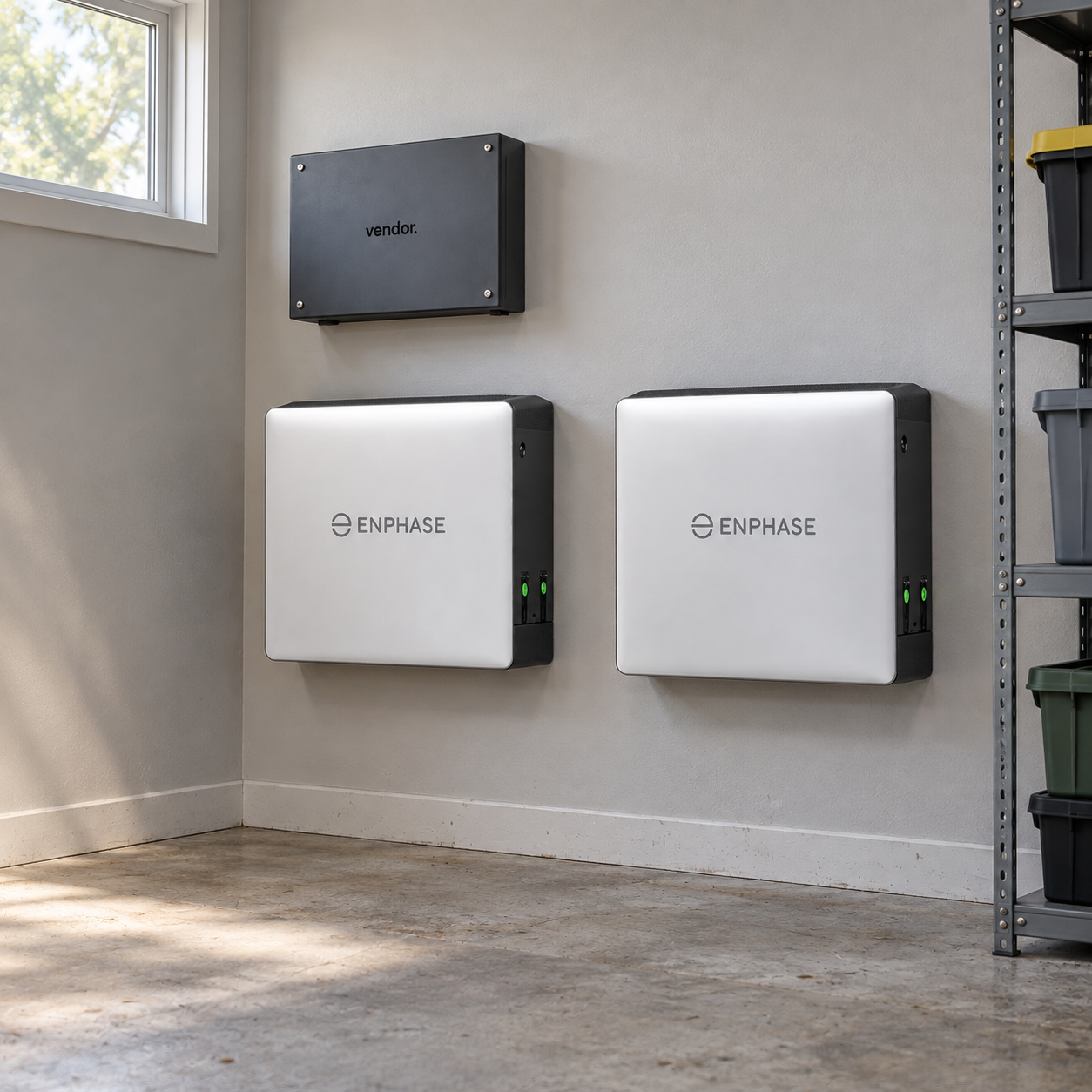
Give electricity a different schedule
Solar production and household demand do not always arrive together. Storage lets you save some energy for another time, including after sunset. It does not create electricity, and some energy is lost during charging and discharge. Its value comes from making energy available when it is more useful. [1]
Two numbers tell different stories
Capacity, measured in kilowatt-hours (kWh), describes how much energy a battery stores. Power, measured in kilowatts (kW), describes how quickly it can deliver energy. A large capacity does not automatically mean a battery can start your air conditioner. The system must also handle its operating demand and startup requirements. Think about the appliances you want to run together, as well as how long you want them available.
Tesla and Enphase: compare the actual model
Powur’s public storage page lists Tesla and Enphase. The important distinction is the model and the complete installed system. For example, Tesla specifies Powerwall 3 at 13.5 kWh of nominal energy, with output configurations up to 11.5 kW AC. Enphase’s IQ Battery 5P has 5 kWh of usable energy and 3.84 kW continuous output; its newer IQ Battery 10C has 10 kWh and 7.08 kW. Those different generations should not be treated as interchangeable. Multiple units also change the system’s capacity and power. [2] [3] [4] [5]
| Battery model | Energy per unit | Continuous AC output |
|---|---|---|
| Tesla Powerwall 3 | 13.5 kWh nominal | Up to 11.5 kW; configuration dependent |
| Enphase IQ Battery 5P | 5 kWh usable | 3.84 kW |
| Enphase IQ Battery 10C | 10 kWh usable | 7.08 kW |
Manufacturer ratings; see sources 3–5. Models shown are examples, subject to market availability. System configuration, controls, and number of units affect the result.
Start with a backup plan, then choose the hardware
A refrigerator, internet equipment, lights, and a few outlets make a different backup assignment from central cooling, electric cooking, and an electric vehicle charger. Ask which circuits will be backed up, whether load controls are required, and what will happen if too many appliances run together. A battery installation needs appropriate controls and a safe grid-disconnection arrangement to provide outage backup. Tesla’s system explanation describes a gateway that detects a grid outage and isolates the home before backup operation. The equivalent controls, permitted circuits, and installation design need to be identified for whichever system you choose. [6]
How long will it last?
For a simplified example, 10 kWh available to household loads divided by a steady 1 kW load gives 10 hours. Double the load and that arithmetic becomes five hours. Real runtime also depends on reserve settings, temperature, conversion losses, appliance cycling, battery condition, and solar recharging. This is an explanation of the calculation, not a runtime prediction for either product. Ask for estimates for your essential-load plan and a heavier-use scenario.
The everyday benefits—and the tradeoff
A battery can increase the amount of your own solar energy you use. Where rates vary by time, charging and discharging around those rates may help manage costs. Any savings calculation needs the actual tariff, export credits, losses, and operating strategy. Reserving more charge for an outage can leave less available for daily rate shifting. Ask how the system balances those priorities and whether any grid-service program affects your reserve. Backup value and financial payback deserve separate conversations.
What should be in a useful battery comparison?
Compare proposals using the same backup assignment: the same circuits, the same desired runtime, and the same assumptions about solar recharging. Ask for usable energy, continuous output, motor-start capability, reserve settings, expansion limits, and compatible control equipment. Review the written warranty for years, retained capacity, usage limits, and exclusions. Then compare installed cost, including electrical work and load controls. A lower equipment price is not necessarily a lower complete-system price, and a higher storage capacity is not automatically a better fit.
Sources & further reading
Information reviewed October 31, 2026. Follow the linked primary sources for complete guidance and updates.
- Solar energy and storage basicsU.S. Department of Energy
- Home battery storagePowur
- Powerwall 3 specificationsTesla
- IQ Battery 5P data sheetEnphase
- IQ Battery 10C data sheetEnphase
- Tesla Backup Gateway 2 specificationsTesla
Specifications shown here are manufacturer examples, not a statement that every model is offered in every market. Your proposal identifies the available equipment, configured output, and supported loads. Battery size alone does not establish whole-home backup or runtime.